
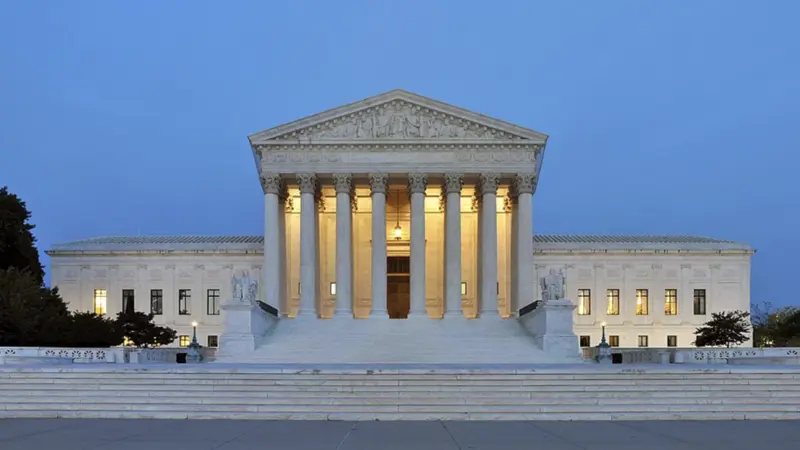
The Trump administration filed its response brief Thursday in the landmark birthright citizenship case headed to the Supreme Court, laying out a constitutional argument that could fundamentally reshape American immigration law and close one of the most widely exploited loopholes in the nation's immigration system.
The case centers on President Trump's executive order directing federal agencies to reinterpret the 14th Amendment's Citizenship Clause to exclude automatic birthright citizenship for children born in the United States to illegal immigrants and foreign tourists. The Supreme Court is expected to hear oral arguments on April 1.
The Constitutional Argument
At the heart of the administration's brief is a textual and historical argument about what the 14th Amendment's framers actually intended when they wrote the Citizenship Clause in the aftermath of the Civil War. The clause grants citizenship to all persons "born or naturalized in the United States, and subject to the jurisdiction thereof" — and it is those five words, "subject to the jurisdiction thereof," that form the crux of the debate.
The Trump administration argues that the Citizenship Clause was designed with a specific and limited purpose: to grant citizenship to freed slaves and their children, who were born in the United States, lived here permanently, and owed their full allegiance to the country. That historical context, the administration contends, defines the scope of the clause's application.
"Children of temporarily present or illegal aliens do not qualify because their parents are not domiciled in, and thus do not owe the requisite allegiance to the United States," the brief states. "Temporarily present aliens are by definition not domiciled here, while illegal aliens lack the legal capacity to form such a domicile."
The argument draws a clear legal distinction between individuals who are permanently domiciled in the United States — and therefore owe the kind of full allegiance the amendment's framers had in mind — and those who are present temporarily or illegally, and whose ties to the country are by definition transient or unlawful.
Why the Order Was Issued
Trump imposed the executive order to address two distinct but related phenomena that have become significant drivers of illegal and irregular immigration: birth tourism and anchor babies.
Birth tourism refers to the practice of foreign nationals — often affluent visitors from China, Russia, and other countries — traveling to the United States specifically to give birth on American soil, thereby securing U.S. citizenship for their child and all the benefits that accompany it, with no intention of remaining in the country or contributing to American society. The practice has spawned an entire industry of birth tourism agencies that openly market the service to foreign clients.
The anchor baby phenomenon refers to the practice, common among illegal immigrants, of having children in the United States as a means of establishing a foothold that can complicate deportation proceedings and eventually be used to sponsor other family members for legal status. The term itself has become politically charged, but the underlying dynamic — using childbirth as an immigration strategy — is well-documented and widely acknowledged across the political spectrum.
Both practices exploit what the Trump administration argues is a misreading of the 14th Amendment, one that has transformed a post-Civil War provision designed to protect the citizenship rights of freed slaves into an immigration magnet that no other developed democracy in the world replicates.
A Debate Decades in the Making
The question of whether the 14th Amendment mandates automatic birthright citizenship for the children of illegal immigrants and temporary visitors has been debated by legal scholars for decades. Critics of the current interpretation — including many serious constitutional scholars who are not ideological allies of the Trump administration — have long argued that the "subject to the jurisdiction thereof" language was never intended to apply to individuals whose presence in the country is either unlawful or temporary, and that the current policy is the product of administrative practice rather than binding Supreme Court precedent.
Supporters of birthright citizenship counter that the 14th Amendment's text is clear and that any child born on American soil is automatically a citizen, regardless of the parents' immigration status. That has been the operating assumption of the federal government for well over a century, though the Supreme Court has never directly ruled on whether it applies to the children of illegal immigrants.
The April 1 oral arguments will give the Court its most direct opportunity yet to resolve that question — and the Trump administration's brief has set the stage for what promises to be one of the most consequential constitutional arguments in a generation.
The Stakes
The outcome of this case will have profound implications for American immigration policy for decades to come. If the Supreme Court upholds Trump's executive order and endorses the administration's interpretation of the 14th Amendment, it would effectively end automatic birthright citizenship for the children of illegal immigrants and foreign tourists — eliminating one of the primary incentives driving both anchor baby births and the birth tourism industry.
For a country that has grappled for generations with the downstream consequences of an immigration system that rewards illegal entry and birth tourism with automatic citizenship, the Supreme Court's ruling in this case may prove to be among the most consequential immigration decisions in American legal history.
The Supreme Court is scheduled to hear oral arguments in the birthright citizenship case on April 1, 2026.

Get the Exclusive
09.16.2026