
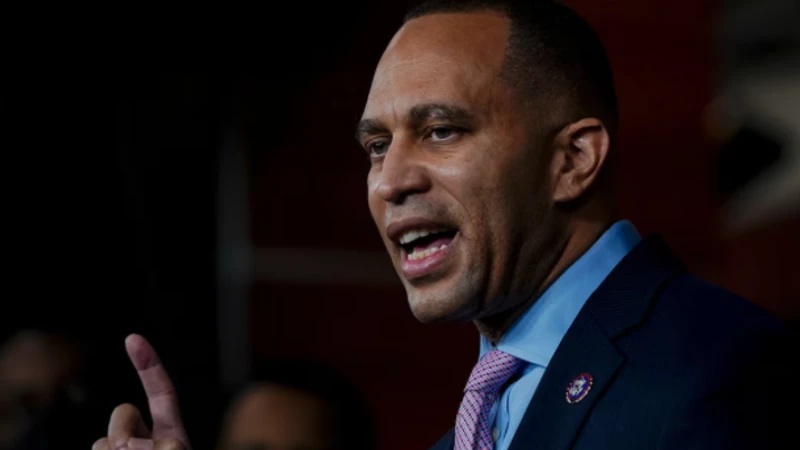
House Minority Leader Hakeem Jeffries has declared the Supreme Court of the United States "illegitimate" and put court-packing explicitly on the table, saying Democrats will pursue every available option to "deal with this corrupt MAGA majority" if they retake Congress in November's midterm elections. The threat — directed at the nation's highest court on the 250th anniversary of the Republic — represents one of the most direct attacks on the judicial branch by a major party leader in modern American history.
"In the new Congress, we're going to have to do something about this Supreme Court," Jeffries told the Meidas Touch network following the Court's ruling in Louisiana v. Callais. "And let me be very clear, everything is on the table, everything to deal with this corrupt MAGA majority that is issuing political opinions that are designed to bolster the prospect of the Republican Party, and we will not allow them to succeed."
Everything on the table explicitly includes expanding the number of justices — packing the Court with enough new members to instantly manufacture a liberal majority, reversing the consequences of three Trump appointments through raw political power rather than the constitutional amendment process.
What the Court Actually Ruled
Before evaluating the response, the ruling itself deserves an honest accounting. In Louisiana v. Callais, the Supreme Court held that Section 2 of the Voting Rights Act does not authorize — and the Constitution does not permit — legislators to manipulate district lines in order to guarantee that candidates of a particular race will be elected. The majority's reasoning was direct: the Voting Rights Act was written to prevent states from giving minority voters less opportunity because of their race, not to require states to engineer districts that guarantee racial outcomes.
The Court did not strike down the Voting Rights Act. It did not eliminate voting rights protections. It held that racial gerrymandering — drawing lines specifically to guarantee a candidate of a particular race wins — is itself a form of racial discrimination that the law does not sanction and the Constitution does not permit.
Chief Justice John Roberts has addressed this principle directly in past opinions: "The way to stop discriminating on the basis of race is to stop discriminating on the basis of race." That is a principle upon which serious people of good faith can disagree, as the 36-page majority opinion makes clear. What it is not is the death of voting rights in America — which is how much of the press immediately characterized it.
A Campaign of Delegitimation
Jeffries's single-word summary of the Court — "illegitimate" — is the culmination of a years-long campaign by Democratic politicians and left-leaning legal academics to strip the Court of its institutional authority in the public mind, preparing the ground for the radical restructuring they have been privately planning.
The campaign has been conducted at multiple levels. UCLA Law Professor Richard Hasen ran a Slate column titled "The Slaying of the Voting Rights Act by the Coward Alito." Berkeley Law Dean Erwin Chemerinsky, who has called conservative justices "partisan hacks," recently authored a book titled "No Democracy Lasts Forever: How the Constitution Threatens the United States." Harvard Law professor Ryan Doerfler and Yale's Samuel Moyn published a column in December calling for Americans to "reclaim America from constitutionalism" and declaring "it's time to accept that the US Supreme Court is illegitimate and must be replaced."
Rep. Jamie Raskin joined the chorus after the redistricting ruling, calling for Democrats to "transform the way the Supreme Court has been gerrymandered itself and stacked and packed with MAGA appointees." Democratic strategist James Carville, characteristically blunt, said flatly: "They're going to recommend that the number of Supreme Court justices go from nine to 13. That's going to happen, people." He added: "Don't run on it. Don't talk about it. Just do it."
Former Attorney General Eric Holder has been equally candid about the underlying motivation. In pushing the court-packing plan, he explained the goal with disarming clarity: "[We're] talking about the acquisition and the use of power, if there is a Democratic trifecta in 2028."
Not justice. Not constitutional fidelity. Power.
The Selective Outrage
What is conspicuously absent from the current delegitimation campaign is any comparable movement during the decades when the Court had a liberal majority that routinely set aside long-standing precedent. Roe v. Wade. Miranda. The expansion of the Commerce Clause. The reinterpretation of the Establishment Clause. Through all of it, no prominent Democratic politician declared the Court illegitimate. No mainstream law school dean called liberal justices partisan hacks. No Democratic House leader threatened to pack the Court because it ruled in ways that helped the Democratic Party.
It was only when a durable conservative majority emerged — three of whose members were appointed through the entirely constitutional process of presidential nomination and Senate confirmation — that the Court became, in the Democratic political vocabulary, corrupt, illegitimate, and in need of structural transformation.
The justices being targeted are not outliers. A significant majority of Supreme Court opinions are unanimous or near-unanimous. The handful of 6-3 decisions that break along ideological lines represent a small fraction of the Court's annual output. Notably, just last week it was President Trump himself criticizing conservative justices for ruling against his administration — hardly the behavior of a court issuing "political opinions designed to bolster the prospect of the Republican Party."
What Is Actually at Stake
The man who would become Speaker of the House if Democrats retake power in November has declared the Supreme Court of the United States illegitimate because it issued a ruling he disagrees with. He has promised that everything — including the fundamental restructuring of the third branch of the federal government — is on the table if his party wins.
This is not normal democratic opposition. It is a stated plan to use a temporary electoral majority to permanently restructure the constitutional order — to pack a court that Democrats cannot win through the appointment process with enough new justices to guarantee the outcomes they prefer, and then to hold that majority through a compliant judiciary that will sustain whatever policies a Democratic trifecta enacts.
The Founders designed the Supreme Court's independence specifically to resist exactly this kind of political pressure. The nine-justice Court, the lifetime appointments, the confirmation process — all of it was constructed to insulate the judiciary from the passions of temporary majorities.
On the 250th anniversary of the Republic, the man who could be the next Speaker is promising to tear that insulation away. Americans should take him at his word.
The Supreme Court's decision in Louisiana v. Callais was issued this week. House Minority Leader Jeffries's comments were made in an interview with Meidas Touch.

Get the Exclusive
10.22.2026