
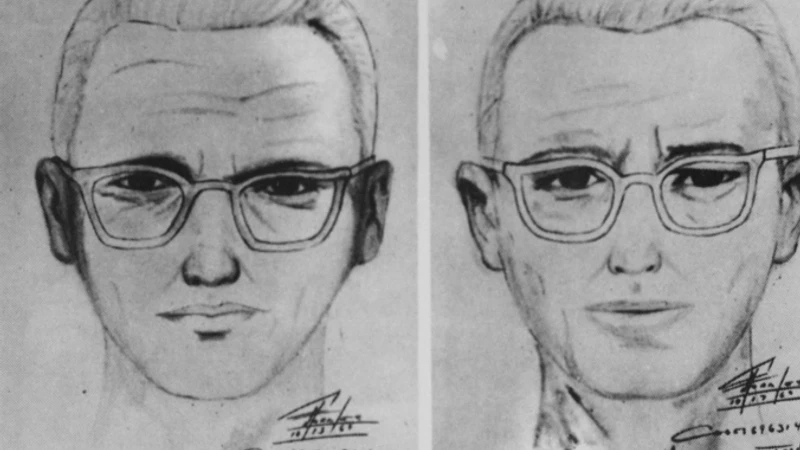
An independent cold case investigator says he has cracked one of America's most infamous unsolved ciphers — and the answer points to a stunning conclusion: the Zodiac Killer may have begun his murderous career 23 years before his known Northern California killings, with the 1947 murder of Elizabeth Short, better known as the Black Dahlia.
Alex Baber, co-founder of Cold Case Consultants of America, presented his findings publicly Saturday at the East Hampton Library during the Hamptons Whodunit event, after nine months of work cracking what he describes as a double-layered encryption involving transposition and substitution in a two-by-seven grid. Using a combination of proprietary artificial intelligence software and self-taught cryptography, Baber says he decoded the Zodiac's 13-character "Z13" cipher to read "Marvin Merrill" — which he subsequently determined was an alias for a man named Marvin Margolis.
Margolis, Baber says, dated Elizabeth Short in the 1940s, appeared on the LAPD's suspect list following her gruesome 1947 murder and dismemberment, and was one of 22 persons of interest identified in the grand jury investigation. If Baber's findings hold up, the Zodiac Killer's cryptic taunts to police were not just acts of narcissism — they were a twisted tribute to his first victim, whose first name, Elizabeth, turns out to be the key to unlocking the very cipher that concealed his identity.
"Elizabeth was the key to solving the Z13," Baber told Fox News Digital. "Her name generates a numerical sequence used to rearrange the cipher."
LAPD Approaches Suspect's Family for DNA
Baber's most significant claim is not just the cipher solution — it is what has happened since. He says the Los Angeles Police Department has, for the first time in the history of the Black Dahlia investigation, approached the family of a suspect to obtain DNA.
"Currently, for the first time in history, LAPD detectives approached the family of a suspect to obtain DNA," Baber said. "That's never happened for the Black Dahlia case. We got a pretty good feeling that we're sitting in the right seat." The LAPD did not immediately respond to a request for comment. An FBI spokesperson declined to weigh in. But if accurate, the DNA outreach represents an extraordinary development in a case that has remained unsolved for nearly eight decades.
A Son's Reaction — and a Haunting Sketch
Baber's account of his interview with Margolis's surviving son is one of the most striking details in a story full of them. When Baber revealed his findings, he says the son "immediately turned white, his hands started shaking and he reached across the table — when he grabbed my hand."
"First time I've ever had an interview where they've initiated physical contact with me," Baber said. "And at that point, he says, 'We're gonna be OK.'"
The son also provided handwriting samples that Baber says show matching phonetic spelling errors between Zodiac's writings and Margolis's known documents — a linguistic fingerprint that Baber and a former NSA codebreaker who peer-reviewed his decryption both found significant.
But perhaps the most chilling detail of all was a sketch the son produced from his phone — a drawing labeled "Elizabeth" across the bottom, made by Margolis 46 years after Short's death. When Baber examined the sketch in person, he says he discovered indentations on the page from a pencil tip used to add texture to the inked drawing — indentations that coincide with injuries sustained by Elizabeth Short. He also says an impression of the word "Zodiac" is hidden within a dark section of the image.
"The first thing I said is, 'Holy s---,'" Baber recalled.
The Cryptographer Connection
Baber also identified what he describes as a notable connection between Margolis and encryption. Margolis's roommate at the time of Short's murder was a man named Bill Robinson — who had been personally selected by General Douglas MacArthur as one of his cryptographers during World War II. Police records from the original 1947 investigation, which Baber obtained, confirm that Margolis and Robinson lived together in Los Angeles at the time of Short's death.
The implication is significant: if Margolis wanted to construct an unbreakable cipher decades later, he had ready access to expert-level encryption knowledge from someone in his inner circle.
Margolis himself served as a medic in the Pacific during World War II — a detail that criminal profiler and psychoanalyst John Kelly, who reviewed Baber's materials, flagged as particularly noteworthy.
"The career field that produces the most serial killers is the medical field," Kelly told Fox News Digital, pointing to infamous cases such as Dr. Harold Shipman, who killed more than 200 patients, and nurse Charles Cullen, who killed dozens. Notably, five of the 22 original suspects in the Black Dahlia case were doctors.
"In my opinion, this guy fits like a glove," Kelly said of Margolis.
Peer-Reviewed and Under Investigation
Baber says he shared his cipher solution with the FBI after cracking it and had it peer-reviewed by multiple outside experts. One of those reviewers — whom he described as a former NSA codebreaker — reverse-engineered his decryption methodology and confirmed the findings through an independent approach, arriving at the same conclusion: Elizabeth Short's first name is the key to the Z13 cipher.
The Black Dahlia murder is one of the most famous unsolved cases in American history. Elizabeth Short was found brutally murdered and dismembered in a Los Angeles vacant lot in January 1947. The case generated enormous public attention at the time and has never been officially solved. The Zodiac Killer, separately, terrorized Northern California in the late 1960s and early 1970s, taunting investigators with cryptic letters and ciphers — several of which have never been solved.
If Baber's theory is correct — that a single killer committed both crimes, leaving the Black Dahlia's name hidden in code as a private tribute to his first victim — it would represent one of the most remarkable cold case breakthroughs in modern forensic history.
Whether DNA evidence ultimately confirms or refutes the theory remains to be seen. For now, after nine months of work, a cipher cracked with AI and cryptography, a shaken son who reached across a table and said "we're gonna be OK," and a sketch labeled "Elizabeth" with indentations that match a victim's wounds, Alex Baber believes he is sitting in exactly the right seat.

Get the Exclusive
09.16.2026