
Republicans have not controlled the White House, the Senate, and the House simultaneously since the early years of the George W. Bush administration. They have a president in Donald Trump who is "acutely attuned," in the words of one House Republican, to the urgent need for election reform. They have a bill — the MEGA Act — that its sponsors call the most comprehensive package of election integrity reforms in a generation. They have polling showing more than 70 percent of the American public supports its core provisions.
And Senate Majority Leader John Thune is doing his level best to make sure none of it becomes law.
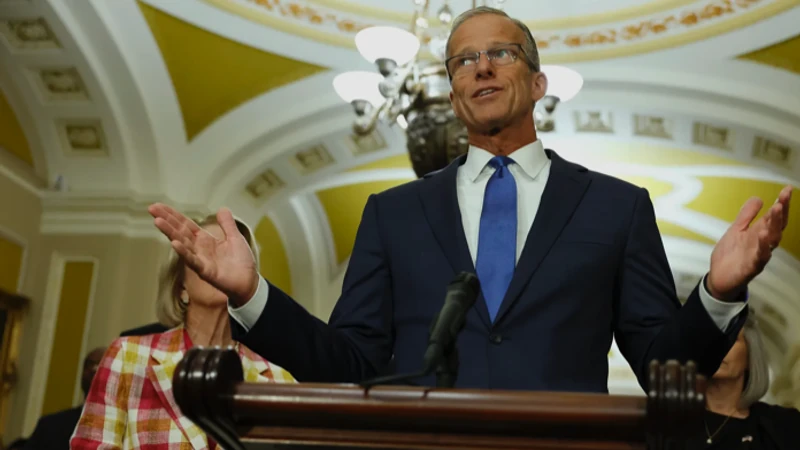
"There isn't anything I can do," Thune told reporters earlier this week, throwing his hands up at the prospect of passing even the more modest SAVE America Act — the portion of the broader MEGA Act requiring documentary proof of citizenship to register to vote and a photo ID to cast a ballot. Both are supported by overwhelming majorities of Americans across party lines. Neither will apparently clear the United States Senate on Thune's watch.
What the MEGA Act Would Do
The legislation, unveiled in late January by Rep. Bryan Steil (R-WI), chairman of the House Administration Committee that oversees federal elections, is sweeping in its scope and long overdue in its ambitions. Among its provisions: requiring states to verify citizenship when registering voters, implementing stronger voter list maintenance requirements, mandating photo identification to vote, requiring mail-in ballots to be received by the close of polls on election day, requiring states to use auditable paper ballots, banning ballot harvesting, banning ranked-choice voting, and banning universal vote by mail.
"The MEGA Act is the most comprehensive package of election reforms in a generation," Steil said at a roundtable discussion last month. He is right. Each provision addresses a documented vulnerability in the American election system — vulnerabilities that have fueled years of public doubt about the integrity of electoral outcomes.
Election law expert Hans von Spakovsky, senior legal fellow at The Edwin Meese III Institute for the Rule of Law at Advancing American Freedom, endorsed the legislation without reservation. "This bill is needed to correct and fix longstanding problems in election administration, some caused by prior federal statutes that restrict the ability of state election officials to maintain accurate voter registration lists," von Spakovsky said. "It will benefit all voters by helping ensure the security and integrity of their most precious right — the right to vote."
Ken Cuccinelli, national chairman of the Election Transparency Initiative, agreed, saying the SAVE America Act and the broader MEGA Act will "fix structural weaknesses in federal election law." Even the vehement opposition of the League of Women Voters — a reliably left-leaning organization that has fought virtually every meaningful election integrity measure in recent memory — serves as a kind of backhanded endorsement. When the League hates a bill, conservatives can be fairly confident it is hitting the right targets.
Thune's Surrender
Which brings us back to the Senate majority leader and his theatrical helplessness. Thune's argument is that Republicans simply do not have the votes to overcome the 60-vote threshold required to end debate on the bill, and therefore there is nothing to be done. He has declined to push for a talking filibuster — a procedurally difficult but constitutionally available path that would at least force Democrats to stand on the floor of the United States Senate and publicly defend their opposition to election integrity measures supported by more than 70 percent of their constituents.
Instead, Thune is reportedly considering a prolonged debate period designed primarily to generate political optics — forcing Democrats on record against popular legislation without actually fighting to pass it. It is the Washington establishment's preferred approach: the appearance of effort without the inconvenience of results.
The math Thune cites is real, but it is also, at least in part, a math of his own making. By refusing to employ the talking filibuster and declining to apply real pressure on wavering members of his own caucus, Thune is ensuring the bill fails rather than giving it a fighting chance. At least one Republican senator is on record saying she will not support the bill at all. Others are reportedly desperate to avoid a vote altogether. A true majority leader would be working the phones, applying pressure, and making the political cost of obstruction higher than the cost of support.
"This is really 100 percent on Leader Thune," Rep. Anna Paulina Luna (R-FL) told Fox Business this week. "I know for a fact the American people have told their senators what they want, both Democrats and Republicans."
She is not wrong. A new Harvard CAPS/Harris poll found 71 percent of Americans support the SAVE America Act, including 69 percent of independents. Support for voter ID stands at 81 percent overall — including 79 percent of independents and even 70 percent of Democrats. Three-quarters of those surveyed back proof of citizenship to vote. These are not close numbers. They are not partisan numbers. They are a mandate.
A Crisis of Confidence
The stakes are not abstract. A poll released last month by the Center for Transparent and Trusted Elections found that just 60 percent of Americans are confident that votes will be counted accurately in the 2026 midterms — a stunning 17-point drop since just after the 2024 presidential election. That collapse in public confidence has occurred against the backdrop of ongoing FBI investigations into election irregularities in Georgia and Arizona, and the release of documents detailing how the Biden administration and its allies coordinated to influence election-related prosecutions.
Americans are paying attention. They are drawing conclusions. And their confidence in the system is eroding in real time.
The SAVE America Act — to say nothing of the fuller MEGA Act — would go a long way toward addressing that confidence crisis. Citizenship verification, photo ID, paper ballot requirements, and a ban on ballot harvesting are not radical proposals. They are standard practices in most of the world's functioning democracies, including many that the American left holds up as models of civic virtue. The idea that requiring a photo ID to vote is somehow suppressive has always been a transparently political argument, and the polling bears that out.
The Window Is Closing
Rep. Steil has framed this moment with the clarity it deserves. "I think we have an opportunity here with President Trump in the White House, who is acutely attuned to the exact challenges we face in elections and the need to reform them, that this is our moment in time to substantively fix U.S. elections so that Americans once again have full confidence in the results we see as tallied on election night," he said.
That window will not stay open indefinitely. Midterm elections have a way of scrambling congressional majorities. The political alignment that makes comprehensive election reform possible today may not exist in 2027. John Thune and his colleagues who are more interested in the comforts of Washington than the will of the people they represent are gambling with something far more important than their own political futures.
They are gambling with the public's trust in democracy itself. And they are losing.
The SAVE America Act is expected to come to the Senate floor for a vote in the coming days. Prediction markets gave the bill an 11.4 percent chance of becoming law as of early Friday morning.

Get the Exclusive
09.16.2026