
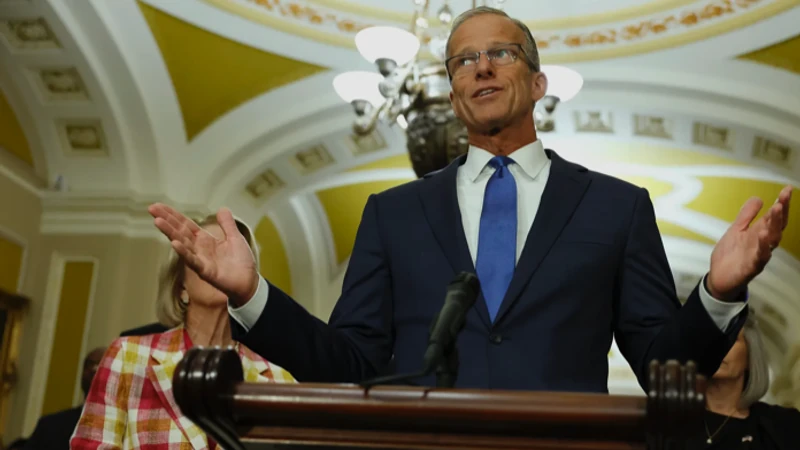
Senate Majority Leader John Thune is once again standing between the Trump administration and accountability. Two months after the Justice Department formally requested transcripts and records related to former CIA Director John Brennan from two Senate committees — setting a hard deadline of February 23 for compliance — the Republican-controlled Senate has not turned over the evidence, slowing a grand jury investigation into whether Obama and Biden-era officials engaged in a conspiracy to weaponize the intelligence community against President Donald Trump.
The standoff is as remarkable as it is frustrating. A Republican Senate majority, in a Congress that itself referred Brennan for prosecution, is withholding evidence from a Republican Justice Department trying to build that very case. All that is required is a resolution and a floor vote. Neither has happened.
"All that is needed, senators told Just the News, is a resolution to be introduced and a floor vote in the GOP-controlled Senate," Just the News reported. "Neither has happened — even after prosecutors narrowed their requests to evidence related to Brennan."
What DOJ Is Asking For
The letters from Assistant Attorney General Patrick Davis to the Senate Judiciary and Senate Intelligence Committees — obtained by Just the News — spell out precisely what federal prosecutors need. They requested "fully unredacted copies of classified and unclassified transcripts of the Committee's interviews, depositions, briefings, and hearings with any witnesses, as well as any written responses provided by witnesses" related to three specific categories: the January 2017 Intelligence Community Assessment on Russian election interference, documents related to the Steele dossier and its inclusion in that ICA, and allegations of collusion between the 2016 Trump campaign and Russian officials.
The request was straightforward. The deadline was February 23. It has now been nearly two months since that deadline passed.
Thune's team has told the DOJ that the Senate leader is attempting to secure unanimous consent to transmit the evidence, trying to negotiate with Democrats to avoid a floor vote he apparently fears would slow down other legislation. In the meantime, prosecutors were recently allowed to read one Senate Intelligence Committee report in a secure room — a grudging half-measure that falls far short of what investigators need to build their case.
The contrast with the House is stark. The House had already voted to transmit similar evidence from its side of the Capitol to the DOJ. The Senate, under Republican control, has not.
A Pattern of Thune Obstructionism
This is not the first time Thune has emerged as an obstacle to the Trump agenda and its accountability mission. As this publication has previously reported, Thune has been the central figure blocking the Save America Act — the election integrity legislation requiring citizenship verification and photo ID to vote that polls show is supported by more than 70 percent of Americans, including 70 percent of Democrats. He has refused to employ a talking filibuster, refused to apply real pressure on wavering members of his caucus, and allowed the most consequential election security legislation in a generation to die on the vine.
Now he is slow-walking evidence in what may be the most significant political accountability prosecution in modern American history. The grand jury investigation, based in Fort Pierce, Florida, is examining whether Obama and Biden-era officials engaged in a conspiracy to weaponize law enforcement and intelligence tools against Trump and his supporters. Brennan is the most prominent target. The evidence Thune is sitting on could be central to the case.
Trump has not hidden his frustration. The president has openly fumed about Thune's unwillingness to eliminate the 60-vote filibuster and his failure to deliver on core legislative priorities. The two-month delay in the Brennan evidence delivery threatens to intensify that tension further.
DiGenova Takes the Lead
As Thune dawdles, the Trump administration is ramping up its resources for the weaponization investigation. Former U.S. Attorney and Independent Counsel Joseph diGenova has been dispatched to take over as the new lead prosecutor on Russia collusion matters, with former Acting Attorney General Todd Blanche expanding resources in both Fort Pierce and Washington, D.C.
DiGenova is not a soft appointment. As the chief federal prosecutor in Washington under President Ronald Reagan, he led the sprawling corruption prosecution of D.C. Mayor Marion Barry that secured a dozen convictions. He prosecuted convicted Israeli spy Jonathan Pollard. He served as Independent Counsel in a Bush administration probe and as a Special Counsel investigating Teamsters union corruption. He is a veteran of politically sensitive, high-profile federal prosecutions — exactly the kind of experienced, aggressive prosecutor that a case of this magnitude demands.
The career prosecutor previously running the weaponization probe has been returned to her regular post in Miami, signaling a reorganization of the effort under diGenova's leadership. The investigation is clearly accelerating — which makes Thune's continued delay of critical Senate evidence all the more inexplicable and infuriating.
Brennan Calls It a Witch Hunt
Brennan himself has been informed he is the target of the investigation, according to a letter his attorneys sent to a federal judge in Miami in December arguing there was no "legally justifiable basis" for the probe. The Obama-era CIA director has taken to the airwaves — he currently serves as a senior national security and intelligence analyst for NBC News and MSNBC, commanding speaking fees of $50,000 to $75,000 per appearance — to paint himself as a victim.
"I think this is unfortunately a very sad and tragic example of the continued politicization of the intelligence community, of the national security process," Brennan said last summer.
The man who oversaw the preparation of an Intelligence Community Assessment built on a Clinton-campaign-funded dossier, who allegedly lied to Congress about the dossier's role in that assessment, and who is at the center of what investigators describe as a years-long conspiracy to weaponize intelligence tools against a political opponent, is calling the investigation into his conduct "politicization."
The irony is considerable.
The Grand Jury Awaits
John Solomon, citing prosecutors' recent formal request for certified Senate transcripts — exactly the kind of materials Thune is withholding — predicted last week that an indictment decision on Brennan could come within weeks. That timeline depends, in part, on whether the Senate finally complies with what the DOJ has been requesting since February.
One option available to prosecutors if Thune continues to stall: serve the Senate directly with a grand jury subpoena, escalating the pressure to a level that would be considerably more difficult to ignore. Officials told Just the News that this option is on the table.
For the millions of Americans who have watched the architects of Russiagate operate without consequence for nearly a decade — while the targets of their investigations faced indictments, legal ruin, and reputational destruction — John Thune's two-month delay of evidence that could finally produce accountability is a profound disappointment.
The House did its part. The DOJ has its prosecutor. The grand jury is waiting. Now the Senate needs to get out of the way.
The DOJ's February 23 deadline for Senate compliance has passed without the evidence being transmitted. A grand jury subpoena is among the options available to federal prosecutors if the standoff continues.

Get the Exclusive
07.26.2026