
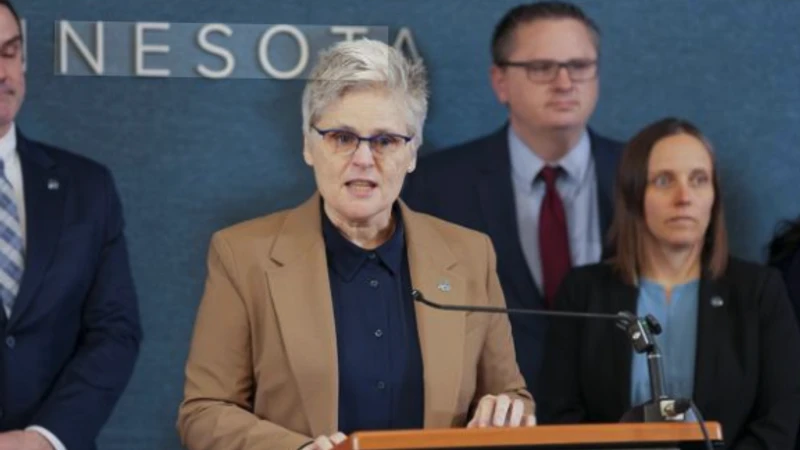
Minnesota state prosecutors have charged a federal ICE agent with two counts of second-degree assault and issued a nationwide arrest warrant for his apprehension, in what Hennepin County Attorney Mary Moriarity described with barely concealed satisfaction as "the first federal agent charged in connection with what happened here in Operation Metro Surge" — and, she believes, the first such prosecution of a federal immigration agent anywhere in the country.
The case centers on ICE agent Gregory Donnell Morgan Jr., who was involved in Operation Metro Surge, the large-scale immigration enforcement operation conducted in the Minneapolis area on February 5. Morgan told investigators he was driving with his partner in an unmarked rented SUV back to the Whipple Federal Building to end his shift when he felt his safety was threatened — ultimately drawing his service weapon on occupants of a vehicle he said had cut him off on Highway 62.
The charges arrive against a backdrop that Moriarity conspicuously omitted from her press briefing: February 5 was a day of organized, aggressive anti-ICE activist operations in Minneapolis, during which activists deliberately tracked, pursued, and physically confronted federal agents to interfere with immigration enforcement. That context is essential to understanding what Morgan says he experienced on that highway.
What Morgan Says Happened
According to the prosecutor's own complaint, Morgan stated that the vehicle he encountered "swerved over in front of him and cut him off." He said he feared for his safety and the safety of others, pulled alongside the vehicle, rolled down his window, drew his firearm, and yelled "Police Stop" in an attempt to get the driver to "back up." He then pulled in front of the vehicle and drove to the federal building.
Morgan's weapon, a Glock 19 with a laser light, was holstered on his right hip at the time. No shots were fired. No one was physically injured.
Prosecutors characterize the incident differently, saying an individual had pulled their vehicle in front of Morgan's — who was allegedly driving in a shoulder lane — to "slow him down." The driver of the other vehicle called 911; the passenger began filming. Prosecutors note the individuals in the other vehicle said they did not know it was a federal vehicle at the time, as it bore no law enforcement markings.
Moriarity's Gleeful Announcement
Hennepin County Attorney Moriarity made no effort to conceal her enthusiasm for the charges. "This is the first federal agent charged in connection with what happened here in Operation Metro Surge," she announced at a press briefing. "Is it the first case of its kind nationally? We believe it is."
The characterization of bringing unprecedented charges against a federal immigration agent as a milestone worthy of celebration speaks volumes about Moriarity's priorities — and the political environment in which this prosecution is being pursued. Moriarity has been among the most vocal local prosecutors in the country in her resistance to federal immigration enforcement, and her office's decision to issue a nationwide arrest warrant for a federal agent who fired no shots and injured no one while working an authorized federal operation raises serious questions about whether this prosecution is about justice or about politics.
"There is now a warrant for Mr. Morgan's arrest, which allows law enforcement to arrest him anywhere in the country," Moriarity said, adding that ICE should make arrangements for Morgan to return to Minneapolis. ICE and the Department of Homeland Security had not commented on the charges at the time of publication.
The Context Moriarity Left Out
The charges cannot be understood without the context in which Operation Metro Surge unfolded. On February 5, anti-ICE activists in Minneapolis mounted an organized campaign to disrupt federal immigration enforcement — physically pursuing unmarked federal vehicles, attempting to block agents, and in multiple documented instances assaulting federal officers to prevent them from carrying out lawful arrests. The operation was conducted in an environment of deliberate, coordinated obstruction aimed specifically at federal agents operating in unmarked vehicles without law enforcement markings.
Morgan was driving exactly the kind of vehicle — an unmarked rented SUV — that anti-ICE activists had been specifically targeting that day. His account of feeling threatened under those circumstances is not implausible. Whether his response constituted a lawful exercise of his authority to protect himself or criminal assault is a question the courts will ultimately decide. But Moriarity's press briefing, which described the incident entirely from the alleged victims' perspective while making no mention of the organized anti-ICE disruption campaign taking place around it, was notably one-sided.
A Dangerous Precedent
The broader implications of this prosecution deserve serious attention. If local prosecutors in politically hostile jurisdictions can charge federal immigration agents with crimes for conduct that occurred during the lawful execution of authorized federal operations, the effect on federal law enforcement operations nationally could be significant and chilling. Federal agents operating in cities governed by officials ideologically opposed to their missions would face the prospect of state criminal charges for judgment calls made under pressure in genuinely dangerous environments.
That is not a hypothetical concern. It is precisely what is happening in Minneapolis. A federal agent drew his weapon — without firing — during an immigration enforcement operation on a day when activists were actively targeting and assaulting federal agents. The result is a nationwide arrest warrant and what Moriarity is proudly billing as an unprecedented prosecution.
The Trump administration has not yet responded formally to the charges. The confrontation between federal immigration enforcement authority and state and local resistance is entering a new and potentially explosive phase — one that will test the constitutional boundaries between federal supremacy and local prosecutorial discretion in ways American courts have rarely been asked to adjudicate.
ICE and the Department of Homeland Security have not yet commented on the charges. A warrant for Gregory Donnell Morgan Jr.'s arrest has been issued and is valid nationwide.

Get the Exclusive
07.26.2026