
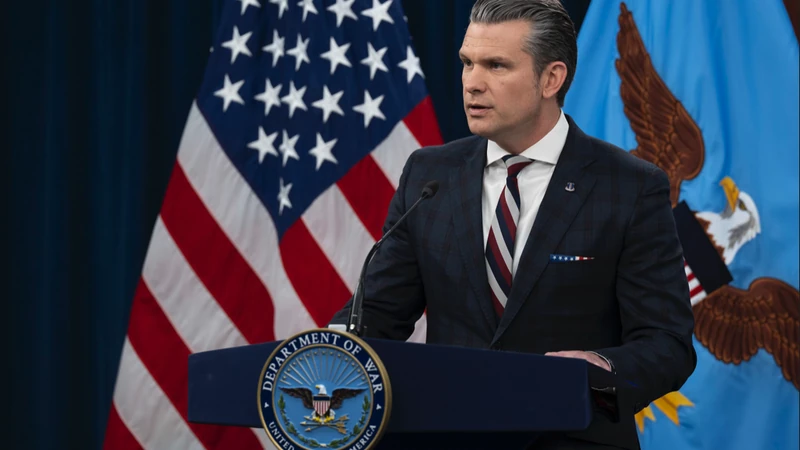
Defense Secretary Pete Hegseth announced Monday that the Pentagon has established a joint task force with the Department of Justice to identify and criminally prosecute government officials who leak sensitive national security information to journalists, according to a statement from the Defense Department.
The task force, which Hegseth described as operating with "the full force of the law," represents a formal coordination mechanism between the country's two largest law enforcement and defense bureaucracies. It is among the most aggressive institutional steps taken yet by the Trump administration to address unauthorized disclosures from within the national security apparatus.
Hegseth did not identify specific cases, individuals, or ongoing investigations that the task force would pursue. He did not specify which categories of disclosure — classified information, sensitive but unclassified material, or operational details — would be prioritized for prosecution. Details about the task force's staffing, investigative authority, and operational structure had not been publicly released as of Monday evening.
The Department of Justice did not issue a separate confirming statement.
The announcement came as the administration is managing the resumption of active military operations against Iran following the collapse of a ceasefire last week. The timing is notable: in periods of active military conflict, counterintelligence concerns within the Pentagon typically intensify, and senior officials have expressed frustration for months with detailed media coverage of internal deliberations over the Iran campaign, including reported accounts of strike planning, intelligence assessments, and personnel decisions.
Federal law broadly prohibits the unauthorized disclosure of classified information under the Espionage Act and related statutes. Prosecutions of government employees for leaking under those statutes have been pursued unevenly across administrations. The Trump administration has signaled it intends to pursue them more aggressively than its predecessor.
The joint structure of the task force — linking Pentagon counterintelligence capacity with DOJ prosecution authority — is designed to carry cases from initial identification through to criminal charges, rather than routing them through administrative or internal disciplinary processes that have historically produced limited accountability for leakers.
The announcement raises several questions that oversight bodies may pursue. What legal threshold must be met before an individual becomes a target of the task force? Will it investigate journalists who receive classified information in addition to government employees who disclose it? What role will the task force play in cases where leaked information concerns potential government misconduct, as distinct from purely operational military matters?
Those questions fall within the oversight jurisdiction of the Senate Judiciary Committee, which is currently navigating a leadership transition. Following the sudden death of Sen. Lindsey Graham (R-SC) on Saturday, Sen. Mike Lee (R-UT) told the Washington Examiner Monday that it would be "hard to turn down" the committee chairmanship if Republicans retain the Senate majority. Graham had chaired the committee.
A special Republican primary in South Carolina will determine the party's nominee to fill Graham's seat. Gov. Henry McMaster on Monday appointed Graham's sister, Darline Graham Nordone, to serve as interim senator and complete the remainder of his term.
The leak task force also arrives alongside a separate pending matter at the Justice Department. Seventy-seven former DOJ officials signed a letter this week urging the Senate to confirm Todd Blanche as Attorney General, calling his record a demonstration that he is "the right man for the right time." Blanche's confirmation status could affect both the pace and the direction of the task force's initial operations.
A source with direct knowledge of leak prosecutions under previous administrations noted that joint task forces of this kind depend heavily on the willingness of the originating agencies — the Pentagon and the intelligence community — to refer cases aggressively. "The mechanism is only as good as the referrals," the source said.
What the task force produces in terms of actual prosecutions will determine whether the announcement represents a substantive shift in how the government enforces its own secrecy laws — or another institutional framework that operates at a distance from the leaks it was created to stop.

Get the Exclusive
10.24.2026