
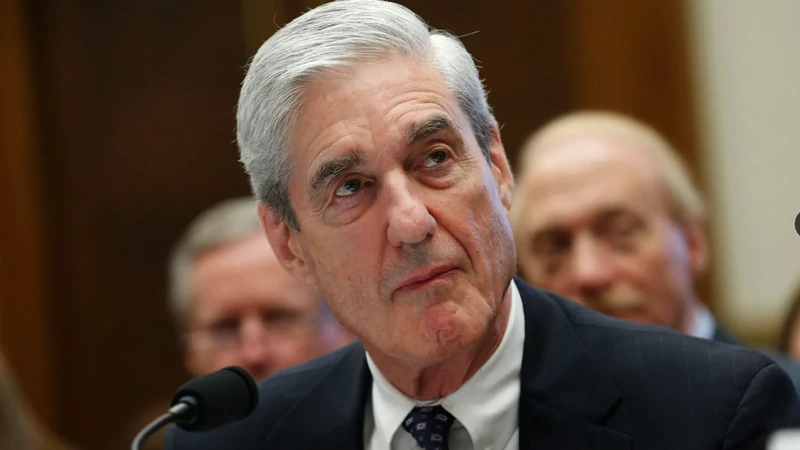
A former FBI agent assigned to Special Counsel Robert Mueller's investigation into the Trump campaign has made explosive allegations of misconduct, political bias, and chronic rule-breaking that permeated the two-year probe — including anti-Trump cartoons plastered on office walls, alcohol consumed on the job, and a "let's get him" mentality that the agent says drove investigators to cut legal corners in their pursuit of a president they despised.
The allegations, first made in December 2020 during an internal FBI probe, were detailed Sunday night in a letter from Senate Judiciary Committee Chairman Chuck Grassley (R-Iowa) to Attorney General Pam Bondi and FBI Director Kash Patel. Grassley called the account deeply troubling, saying it "confirms long-standing concerns that political bias rotted the decision-making process within the Mueller team." He added pointedly: "The American public deserve answers."
Mueller's investigation ran from May 2017 to March 2019, cost American taxpayers more than $30 million, and ultimately found no evidence of collusion between the Trump campaign and Russia. A subsequent review by Special Counsel John Durham in May 2023 described the original Trump-Russia probe as "seriously flawed" and concluded that the FBI "discounted or willfully ignored material information that did not support the narrative of a collusive relationship between Trump and Russia." The new whistleblower allegations suggest the rot went even deeper than Durham found.
Targeting Tom Barrack Without Authority
Among the most damning allegations in the whistleblower's account is the claim that Mueller's team had "no authority" to open a case against Tom Barrack — a billionaire friend of Trump's who served as chairman of his 2017 inaugural committee — over false accusations that he was an unregistered agent of the United Arab Emirates.
The FBI's Washington Field Office had already reviewed the matter and declined to open an investigation. The Mueller team overrode that decision, arrested Barrack, held him in jail, and charged him with being a foreign agent. After a lengthy and expensive legal ordeal, Barrack was acquitted by a jury in 2022. He now serves as the U.S. Ambassador to Turkey. That a man was arrested, jailed, and dragged through years of legal proceedings by investigators who, according to the whistleblower, lacked the authority to open the case in the first place, is a prosecutorial abuse of the first order.
FISA Abuses and a Culture of Surveillance Overreach
The whistleblower also alleges that the Mueller team chronically abused Foreign Intelligence Surveillance Act warrants — the secret court orders that govern monitoring of suspected foreign agents — to target Trump campaign advisers, even renewing surveillance warrants over the explicit objections of FBI agents.
In one particularly striking instance, the agent described a situation in which the target of an investigation was actively cooperating with investigators and the surveillance warrant was producing nothing of value. As the agent recounted: "The target of the investigation was cooperating and the FISA would not give us anything more and there was nothing in the past FISA that aided the investigation other than to prove the Target was being honest with the investigators … there were no corroborating facts that tied the target to certain facts that we thought were originally true."
Despite this, the team moved to apply for a fourth surveillance warrant. When the agent flagged a series of necessary corrections to the application, FBI lawyer Kevin Clinesmith replied: "We can't send this." The Department of Justice subsequently determined the corrections were unnecessary. Clinesmith later pleaded guilty to doctoring an email that formed the basis of a FISA warrant application against Carter Page, another blameless Trump campaign adviser. His punishment was 12 months of probation and a brief law license suspension — a slap on the wrist for conduct that would have resulted in severe consequences for anyone outside the Washington legal establishment.
Prosecutors Breaking Security Rules
The misconduct was not limited to surveillance abuses. The whistleblower alleges that Mueller prosecutor Zainab Ahmad — a protege of Obama-era Attorney General Loretta Lynch — repeatedly violated security protocols governing the handling of classified materials. Among the specific allegations: Ahmad brought a classified notebook to a Washington Field Office meeting without the required secure carrying bag, having transported it directly from her private residence. Keeping classified government materials at a personal residence without proper authorization is a serious federal security violation — the very type of conduct that has resulted in criminal referrals and public condemnation when committed by others.
McCabe's Anti-Trump Bias — And Pressure to Cover It Up
Former FBI Deputy Director Andrew McCabe, one of the most prominent figures in the Russia investigation, is also implicated in the whistleblower's account. The agent alleges that McCabe "referred to President Trump in a derogatory manner" in an official interview record — and that DOJ prosecutors subsequently pressured FBI agent Michelle Taylor to alter the document to remove the "negative connotation" of McCabe's language. Taylor refused to make the changes and left the FBI shortly after her secondment to the Mueller team concluded. Her refusal to falsify an official government record, and the pressure she faced for that refusal, speaks volumes about the culture that had taken hold within the investigation.
Anti-Trump Cartoons on the Walls
Perhaps the most vivid illustration of the investigation's poisoned atmosphere came from the whistleblower's description of the physical office environment itself. The agent described "a general atmosphere of bias led by one young prosecutor, Aaron Zelinsky," noting that "there were caricatures and cartoons that were anti-Trump" displayed openly on the office walls. Zelinsky, who handled the aggressive prosecutions of Trump advisers Roger Stone, George Papadopoulos, and Michael Caputo, resigned from the DOJ in January 2025. The image of federal prosecutors decorating their government office with anti-Trump propaganda while conducting a criminal investigation of his presidency is not a subtle one.
A Reckoning Long Overdue
Taken together, the whistleblower's allegations paint a portrait of an investigation driven not by evidence but by animus — a team of prosecutors and agents who had decided the conclusion before they gathered the facts and were willing to bend, break, and ignore the rules to reach it. The Durham report said as much in 2023. The new whistleblower account provides the granular, on-the-ground detail that transforms Durham's findings from an institutional critique into a human story of specific individuals making specific choices to abuse their power.
Senator Grassley has given Attorney General Bondi and FBI Director Patel until March 29 to produce all emails, files, and personnel records relevant to the agent's allegations. The American people spent more than $30 million funding an investigation that found nothing, conducted by a team that the evidence increasingly suggests never intended to find anything other than what they had already decided was true.
That reckoning is long overdue.
Senate Judiciary Committee Chairman Chuck Grassley has requested all relevant documents from the DOJ and FBI by March 29, 2026.

Get the Exclusive
09.16.2026