
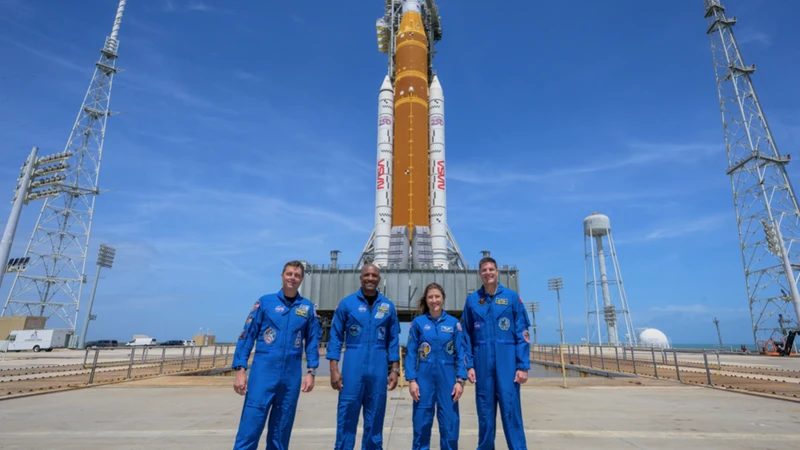
For the first time in more than half a century, American astronauts are leaving Earth's orbit to lay eyes on the Moon. NASA's Orion spacecraft is set to launch Wednesday evening from Kennedy Space Center in Florida, carrying four astronauts on the Artemis II mission — the first crewed lunar voyage since the final Apollo mission concluded in December 1972 and a landmark step toward President Donald Trump's goal of putting boots back on the lunar surface by 2028.
The launch window opens at 6:24 PM on Wednesday, April 1. The crew will embark on a roughly 685,000-mile journey aboard the Orion capsule, swinging around the Moon before slingshotting back to Earth — a mission designed to test the spacecraft's life support systems, hardware, software, and emergency procedures under real deep-space conditions. It is, in every sense, a dress rehearsal for the permanent American return to the Moon that follows.
"America will never again give up the Moon," NASA Administrator Jared Isaacman declared earlier this month.
The Crew
Leading the expedition is Commander Reid Wiseman, a veteran NASA astronaut who has framed the Artemis program not merely as a return to the Moon but as humanity's first step toward a permanent future in the Solar System. Joining him are pilot Victor Glover, mission specialist Christina Koch, and Canadian astronaut Jeremy Hansen — marking the first time in history that a non-American has made the journey to the vicinity of the Moon.
Wiseman's vision for the mission extends far beyond the immediate headlines. "When I look at the future, when we talk about what is our legacy, I don't want to look five years or 10 years in the future. I want to look 100 or 200 years in the future," he told reporters. "I hope we are forgotten. If we are forgotten, then Artemis has been successful. We have humans on Mars, we have humans on the moons of Saturn, we are expanding in the Solar System."
It is the kind of sweeping, generational ambition that has not animated American space policy in decades — and it is back, driven by a president who has made space superiority a cornerstone of his national security agenda.
Trump's Space Vision
The Artemis II launch is a direct product of policy decisions made in both of Donald Trump's administrations. In 2017, during his first term, Trump signed Space Policy Directive 1, redirecting NASA's national mission toward a return to the Moon. In 2019, Vice President Mike Pence put the urgency into words at a National Security Council meeting in Huntsville, Alabama.
"Urgency must be our watchword," Pence said. "The United States must remain first in space in this century as in the last, not just to propel our economy and secure our nation but, above all, because the rules and values of space, like every great frontier, will be written by those who have the courage to get there first and the commitment to stay."
That momentum was slowed — though not entirely extinguished — during the Biden years, as the 2024 landing timeline was quietly abandoned and the program drifted. When Trump returned to the White House, he moved immediately to restore the urgency. A December executive order set the framework for American "space superiority," encompassing both exploration and national security, and established a 2028 target for landing Americans on the Moon as a stepping stone toward Mars.
"Superiority in space is a measure of national vision and willpower, and the technologies Americans develop to achieve it contribute substantially to the Nation's strength, security, and prosperity," Trump wrote in that order. "The United States must therefore pursue a space policy that will extend the reach of human discovery, secure the Nation's vital economic and security interests, unleash commercial development, and lay the foundation for a new space age."
Wednesday's launch is on schedule to deliver on that vision.
The Geopolitical Stakes
The Artemis II mission is not purely a scientific endeavor. It is a geopolitical statement — and one that arrives at precisely the right moment. China has set a 2030 deadline for landing its own astronauts, known as taikonauts, on the Moon. Chinese Communist Party leaders first discussed the possibility of a lunar mission in 1970, the same year China launched its first satellite. In the decades since, China's space program has advanced dramatically, including four unmanned lunar probes since 2004 and an increasingly sophisticated long-term space strategy backed by the full resources of a one-party state.
NASA Administrator Isaacman made the competitive stakes explicit. "We find ourselves with a real geopolitical rival, challenging American leadership in the high ground of space," he said. "This time, the goal is not flags and footprints. This time, the goal is to stay."
The echoes of the Cold War space race are unmistakable — and instructive. The Soviet Union shocked the world in 1957 with the launch of Sputnik, the first satellite ever placed in orbit, and appeared for years to be winning the contest for space supremacy. The United States responded with the focused national will that produced the Apollo program, first reaching lunar orbit in 1968 and landing astronauts on the Moon's surface in July 1969. The Soviets never matched it.
Today's contest with China deserves the same clarity of purpose and competitive urgency. The nation that establishes a sustained presence on the Moon will set the terms — scientific, commercial, and strategic — for the next era of human civilization beyond Earth. The Trump administration clearly understands what is at stake.
What Artemis II Will Accomplish
While Artemis II is not a landing mission — the crew will orbit the Moon rather than touch down on its surface — its objectives are critical to everything that follows. NASA has identified four primary mission goals: demonstrating Orion's ability to sustain its crew through the return to Earth; proving out systems and operational procedures required for future lunar missions; testing the spacecraft's hardware and software under real deep-space conditions; and practicing emergency systems and protocols.
A NASA original March launch date was pushed back after a failure in one of the rocket's systems was identified and corrected — a delay that, while frustrating, reflects exactly the kind of rigorous pre-launch scrutiny that has made American human spaceflight the gold standard for safety and reliability over more than six decades.
A Half-Century in the Making
The last time human eyes looked out upon the lunar surface from close range was December 1972, when astronauts Eugene Cernan and Harrison Schmitt spent more than three days on the Moon's surface in the Taurus-Littrow valley during Apollo 17. Cernan, the last man to walk on the Moon, left a message scratched in the lunar dust before climbing back into the lunar module for the final time. He expressed the hope that humanity's departure was not permanent.
It wasn't. It just took longer than anyone hoped.
On Wednesday evening, from the same Kennedy Space Center that sent Apollo 17 on its way more than 53 years ago, America resumes its journey. Commander Reid Wiseman and his crew are not just making history — they are reclaiming it.
Artemis II is scheduled to launch at 6:24 PM on Wednesday, April 1, from Kennedy Space Center in Florida.

Get the Exclusive
09.16.2026